
In this blog post, I will show how we connect our sustainability strategy with our client projects. You will learn how we think about the footprint and handprint together – and what we understand an Impact Project to be, using 4 concrete examples.
Liip's Sustainability Strategy
Liip's sustainability strategy is based on 3 pillars:
- We reduce the footprint of Liip as an organization.
- We reduce the footprint of the digital products we develop.
- We contribute our expertise to Impact Projects.
Where Does This Structure Come From?
When we talk about sustainability, we distinguish between footprint and handprint.
The footprint describes the negative effects of our own actions – such as CO₂ emissions, resource consumption, or social risks of doing business. It shows where we must take responsibility and reduce our negative impact.
But as important as this is: Individuals and single organizations quickly reach their limits if we only focus on our own footprint. This is because we always operate within systems – economic, political, and social framework conditions that shape our actions.
This is where the handprint comes in. It represents the contribution we make with our work – and above all, for systemic change. That is, changing structures, processes, and business models so that sustainable action becomes the new standard.
Thus for Liip, sustainability therefore means both:
- Consistently reducing one's own footprint.
- Simultaneously and purposefully increasing our handprint.
Only the combination creates an effect that goes beyond the company itself.
Progress Metric
As an agency, a truly significant leverage lies in the projects we realize every year. Digital Progress is about our expertise. And we contribute this to the projects of our clients and partners.
This corresponds to our purpose. And that's why we look closely: Are we living up to our purpose?
At Liip, we have developed a tool we call The Progress Metric:
- The 17 Sustainable Development Goals of the UNO (short: SDG) serve as our framework.
- We analyze to which SDG a project contributes.
- And whether this contribution is negative or positive.
This is our compass:
- Is our contribution – globally speaking – increasing?
- Which projects made a particularly positive contribution last year?
- To which SDGs do we make a (positive) contribution? Which ones receive less attention?
(We include an update on the development of the Progress Metric in our sustainability report.)
Projects that make a positive contribution are called Impact Projects.
Impact projects are not a coincidence for us. They are the result of a conscious decision: We apply our digital expertise where it strengthens socially and ecologically relevant systems.
What is an Impact Project?
To give you a concrete idea, I will introduce 4 Impact Projects that we implemented in 2025.
- MedAI for the Cantonal Disability Insurance Office of the Canton of Vaud (OAI)
- Relaunch for the AOZ
- Relaunch for the Banque Alimentaire Fribourgeoise (BAFR)
- Monitoring platform for Infofauna
Who is the Disability Insurance Office of the Canton of Vaud?
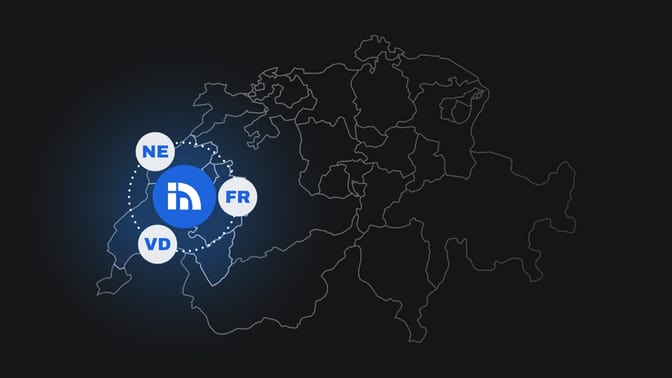
The Cantonal Disability Insurance Office of the Canton of Vaud (OAI) is the cantonal IV office. It is responsible for processing disability insurance cases – particularly for examining medical dossiers necessary for benefit decisions. It operates within the framework of the Swiss social insurance system and works closely with doctors, hospitals, and other medical facilities.
Together, we built MedAI: a scalable, secure, digital platform that simplifies, accelerates, and digitizes the submission and processing of medical reports. Read the full story in our blog post «MedAI: first successes and new developments».
Why is it an Impact Project?
MedAI shows measurable impact where it matters most: for people waiting on a disability insurance decision. Faster decisions for people who depend on this social insurance, less administrative burden for medical staff, and more efficient use of public resources — that's real progress, not just a hypothesis.
To which SDGs does the project contribute?
- Decent work and economic growth (8)
- Reduced inequalities (10)
- Peace, justice and strong institutions (16)
- Good health and well-being (3)
- No poverty (1)
Who is the AOZ?
The AOZ is a public-law institution of the City of Zurich. It is responsible for housing, care, and social assistance for refugees, as well as integration programs for immigrants. Commissioned by the city, municipalities, cantons, and the federal government, it supports people in building linguistic, professional, and social skills and leading as independent a life as possible.
What was the core need behind the project?
A clear, target-group-oriented, barrier-free, and future-proof web platform that provides orientation, strengthens trust, and does justice to AOZ's societal role.
Why is it an Impact Project?
The AOZ is working on central societal challenges: integration, social stability, and equal opportunities. A clearly structured, accessible digital platform facilitates access to information – and thus to support. This strengthens not only individuals but an entire integration system.
To which SDGs does the project contribute?
- Reduced inequalities (10)
- No poverty (1)
- Sustainable cities and communities (11)
- Quality education (4)
- Decent work and economic growth (8)
Who is the Banque Alimentaire Fribourgeoise (BAFR)?
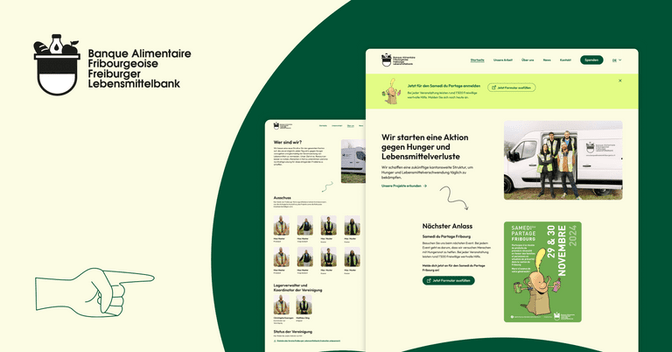
The Banque Alimentaire Fribourgeoise (BAFR) is a non-profit organization that combats hunger and reduces food waste. Every week, it rescues several tons of surplus food from retailers and producers and distributes it just-in-time to around 30 social organizations in the Canton of Fribourg.
Funded through our Liipers' Fund, a team of Liip apprentices – accompanied by their vocational trainers – designed and built BAFR a new, professional, and accessible website that gives the organization more digital visibility to reach donors and people seeking help. Read the full story in our blog post «Support for BAFR: A joint project by apprentices and vocational trainers».
Why is it an Impact Project?
The project strengthens the infrastructure of the non-profit organization. It improves processes, reach, and access – important prerequisites for social impact.
The project had a double impact: It strengthened a social organization – and offered our apprentices real, meaningful project responsibility.
To which SDGs does the project contribute?
- Zero Hunger (2)
- Responsible Consumption and Production (12)
- No Poverty (1)
Who is Infofauna?
Infofauna is the national data and coordination center for wild animal species in Switzerland. Commissioned by the federal government and the cantons, the organization collects and manages data on the animal world and biodiversity and makes it available for research, nature conservation, and authorities.
What was the core need behind the project?
Infofauna needed a future-proof, central platform to structurally record, secure, and make accessible the biological data on water quality throughout Switzerland. The existing solution was technically outdated and not designed to efficiently integrate additional monitoring modules, as well as the requirements of the federal government, cantons, and specialist offices.
To which SDGs does the project contribute?
- Life on land (15)
- Life below water (14)
- Clean water and sanitation (6)
- Partnerships for the goals (17)
- Climate action (13)
Conclusion
Impact Projects have a central importance at Liip:
- They correspond to our purpose.
- They are the handprint of our company and contribute to systemic change.
- Together with our clients and partners, we make a positive contribution to the Sustainable Development Goals.
- They are a central part of the work for many of our employees.
Important: All our clients – whether Impact Project or not – enable us to realize even more Impact Projects in the future.
These four projects exemplify how we increase our handprint: Not through individual campaigns, but through structural improvements in administration, integration, food security, and biodiversity monitoring.
For us, Digital Progress is not an end in itself. But a lever for societal development.