
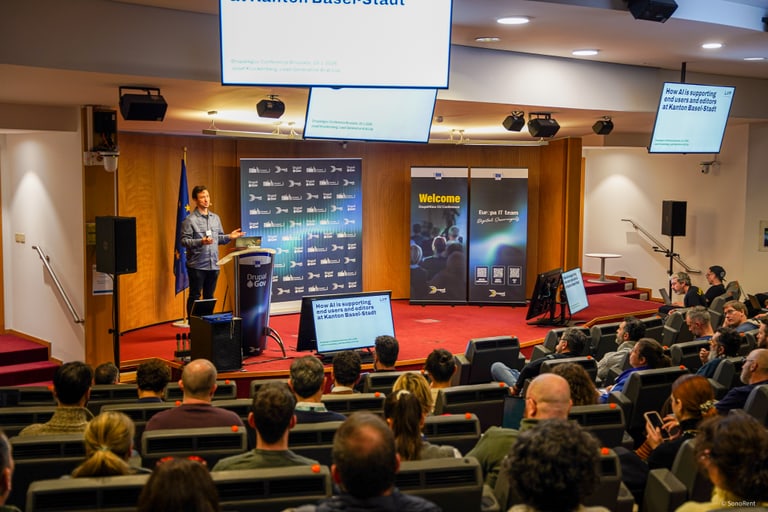
The Drupal4Gov conference was packed with interesting talks. Here, you’ll find here my personal highlights. I was also there to showcase our work on the Kanton Basel-Stadt/Alva/blökkli project. We already wrote about it, but I’ll share with you the current status and new features.
GovNL: From months to minutes to build sites
GovNL combines open source Drupal components and an open design system to run many Dutch government sites in a way that is accessible and scalable. It reduces time to build new sites from 3 months to about 10 minutes, pretty impressive to say the least. This is a strong use case of designing for reuse at large scale.
European Commission: Coordination is key to scaling
The European Commission already runs no less than 770 sites and invests heavily in the Drupal ecosystem! What stood out for me was how much they focus on coordination—making sure the right content is published through the right channel across that landscape. Open source program offices (OSPOs) were established as a way to drive open source agendas both at government level and inside organisations.

Kanton Basel-Stadt website and Alva: a blueprint for local public administration
Just before lunch break, it was time for me to present the different AI use cases we implemented for Kanton Basel-Stadt. The canton set new standards with the bs.ch relaunch with user-centred design, topic-based access instead of internal org structure, and Alva as the first AI-based chatbot for a Swiss canton. The stack is based on open source components and Liip heavily contributed to open source as part of this relaunch. We use Drupal as CMS, Nuxt/Vue, the blökkli editor for the headless frontend and Elasticsearch for search. Content is produced by a cross-department editorial team following a clear content strategy.
AI to support the public and editors of the website
The talk was an opportunity to share figures more than 18 months after the go-live. Today, Alva handles over 10,000 questions per month, with about 1.36 questions per conversation and +44% growth since Alva 2.0. API integrations let the chatbot answer questions based on real-time information. Alva is also used heavily by internal users from the canton as well as the public. The chatbot always shows and validates its sources, which is central to creating trust.
On the editing side, blökkli is working hard to simplify texts. By using the blökkli editor with integrated AI, editors can now run a readability audit, see proposed simplifications side-by-side and accept or adapt them. Alva and the AI features on bs.ch are continuously developed further to provide editors and citizens trustworthy AI technology.
AI assisted technologies at the French Government
Another inspiring talk to watch was Use-cases of AI in the Services Publics+ platform at the French government. With more than 140.000 experiences shared and over a million of reactions, the system uses AI assisted technology to help State service provide feedback to citizens. They leverage speech to text and real-time summaries as an enabling technology. C’est magnifique!
The EU trusts open source more than ever
The European Union introduced Website Evidence Collector that scans sites for security issues and is open source. It was notable that they publish it under the EUPL (European Union Public Licence), which emphasises interoperability between countries and licences and supports multilingual collaboration. I wonder if Switzerland has something similar?
Not only does the EU trust open source for security they also provide through Interoperable Europe a new portal there’s a useful Licensing Assistant. You can find and compare software licences and run a compatibility checker to see if different open source licences can be combined and whether there are legal complications.
Using open source is not enough, we need champions
Finally, Tiffany Farris from strategy consultancy Palantir.net (not to be confused with the infamous Palantir Technologies) stressed that using open source is good, but not enough. You need champions in the organisation who put contribution and ecosystem health on the agenda. Designing for reuse should be a core principle. From a US perspective, procurement is a problem: open source usage has grown, but support mechanisms often haven’t. Treating open source as “free” can lead to contracts going to vendors who brand their work as open source without actually supporting a thriving ecosystem. She proposed concrete public money, public code-style amendments to public procurement to better support the ecosystem. This was really an inspiring conclusion to an intense day of learning and exchanges.
You can watch the playlist if you would like to dive deeper into the presentations from Drupal4Gov EU 2026.