
A tool to make digital sustainability a professional standard
We talked last year already about a tool to evaluate the level of sustainability of Liip's digital projects. Our platform main goal is: to help build websites and apps that are both efficient and eco-friendly.
We want to create digital products that are efficient, accessible, and designed responsibly. As more clients now include sustainability in their requirements, we're ready to show that we can deliver on that and more.
Doing this platform is actually the easy part. The main challenge is about change management: how do we help Designers, Developers, and Business Developers at Liip include sustainability in their daily work? That means tweaking some of our processes.
One approach we took was to create customised training for every production team. At first, it sounded great in theory, but in practice, it was more complex than this. Even though sustainability is important in Liip's culture and DNA, we had to find a balance. Training 150+ people for 2–3 hours each means a lot of time away from their regular work for clients. And unless a project specifically asks for eco-design, it's normal that people wouldn't entirely change their working habits just because of one training session. That's understandable. It's smart to focus on what's needed to stay efficient and deliver projects on time. That's why we decided to offer training only when a project actually needs it.
This brought up another challenge: to upskill our teams, we need clients to be open to auditing their projects. In other words, we need to demonstrate the real added value of eco-design.
The "zero-sum" mindset around web eco-design.
A zero-sum game means one person's win comes at another's loss. From what I experienced so far, digital sustainability is often framed this way, as if you have to choose between ecology versus economic performances, like a trade-off. This polarised thinking makes conversations around sustainability difficult. I sometimes avoid using the word "eco" when talking about the benefits of sustainable design, and focus on more tangible benefits.
The added value of eco-design lies in better accessibility, SEO, and performance, all of which support sustainability through smart technical optimisation and thoughtful design decisions.
There's also a persistent misconception that an eco-designed website will automatically be plain, or boring, just black and white, no images, nothing engaging. This perception of eco-design couldn't be further away from the truth.
Simplicity and sustainability don't have to come at the expense of beauty or engagement. In fact, thoughtful design can make a site both appealing and efficient.
Eco-design, whether it's for a website or a physical product, involves dozens, if not hundreds, of parameters that must be addressed to make the best use of limited resources. In the case of a website, there are even a lot of best practices that were applied when we didn't yet have 3G and powerful smartphones.
So, where are we now?
I hope that one day, we won't need to ask whether something is sustainable; it will simply be part of the process, like ensuring accessibility and responsiveness. Our evaluation tool works as a checklist allowing us to spot potential improvements to plan in future updates and maintenances of the project we deliver.
We're making good progress. Different teams at Liip work in different ways and with different technologies Currently, a few teams at Liip now include sustainability evaluations in offers. Our goal is to make this a standard practice company-wide.
And other projects are on track to help with that. For instance we are internally fine tuning new criteria for AI-based features and products, and we are exploring ways to involve more designers in the process as the design specifications they will provide to developer may have a positive impact in the balance.
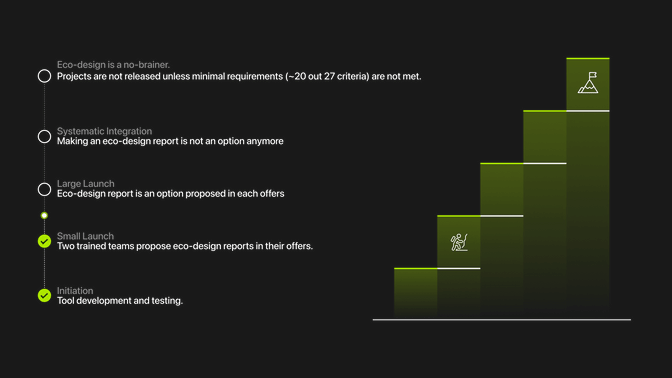
When an assessment is included in a project, we collaborate closely with stakeholders early on to identify and act on key sustainability recommendations. Encouragingly, we've found that many good practices are already embedded in our processes.
At the end of a project, at MVP or go-live, we run a final evaluation to highlight what went well and where we can optimise further. The recommendations can then be prioritised for future updates or maintenance. These improvements not only reduce environmental impact but also enhance accessibility, speed, and overall user experience.
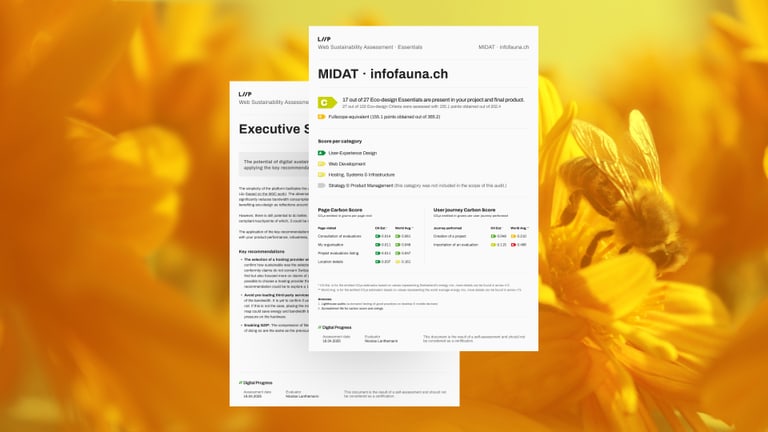
If you want to access a concrete example, check IT4Future for which we made a complete evaluation. It can be found on their eco-design page.
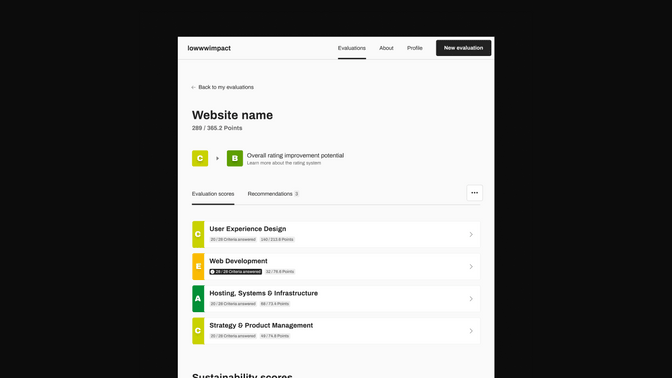
And last but not least: Meet Lowwwimpact
We plan on releasing an update of our platform soon, allowing us to make evaluations much faster internally while providing more concrete value to our clients. I'm positive this will help Liip make eco-design a standard.
We plan to open our platform to everyone, and best of all, you can already sign up for our waiting list to become our first users.
Do you have a question, comment, or inspiration to share? Please do not hesitate to get in touch if you would like to learn more about our approach to eco-design.